Best Master’s in Interior Design Programs in the USA: The Ultimate Strategic Guide

The most important question to ask yourself before submitting your graduate design school applications.
If you are searching for the best Master’s in Interior Design programs in the USA, you will quickly discover that there is no single ranking that can tell you where you should apply. That is because graduate interior design programs can be very different from one another.
Some are strongly focused on spatial experimentation and design research. Others are more professionally oriented. Some expect you to arrive with an undergraduate background in architecture or interior design. Others deliberately create pathways for students changing careers.
So instead of asking, “What is the best interior design school in America?” I encourage students to ask a better question: Which program is best for the designer I want to become?
Here are several programs worth researching. To help you navigate this transition—especially if you are an international student tracking visa-friendly options or a professional changing careers—I have benchmarked the top five US design programs below.
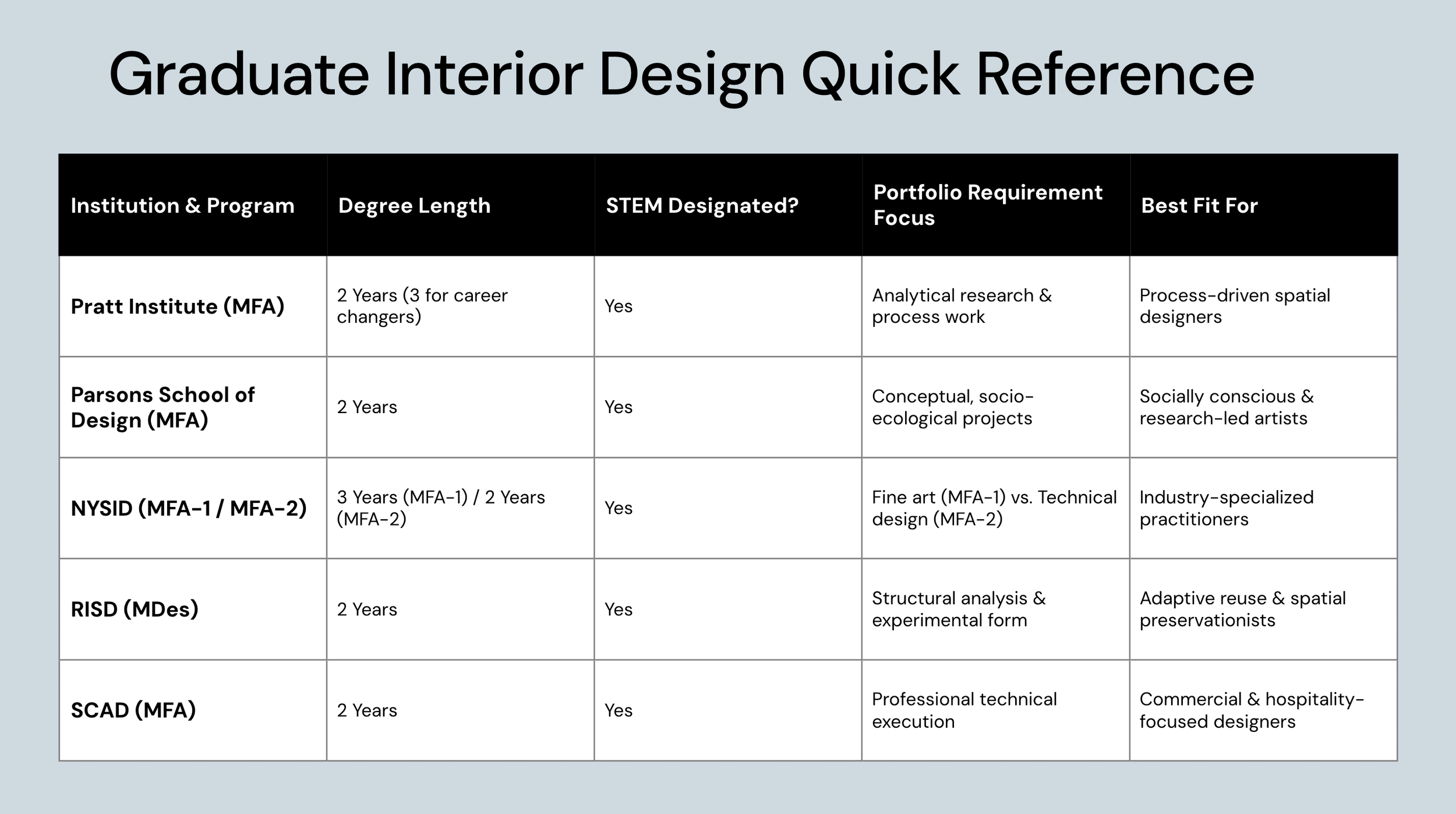
A quick reference comparison chart summarizing the top graduate interior design programs in the United States.
🏛️ Pratt Institute — MFA in Interior Design
Pratt is one of the first programs I would look at if you want a rigorous, studio-based interior design education in New York.
Pratt currently offers two routes into its Interior Design MFA. Students with previous degrees in interior design, architecture, or related fields may be eligible for the 60-credit, two-year MFA. Students coming from unrelated academic backgrounds can complete a 24-credit Core Year before entering the MFA curriculum.
What I particularly like about Pratt from an admissions perspective is that its portfolio guidance goes beyond beautiful final renderings. For applicants to the two-year program, Pratt recommends showing research, process work, physical models and hand drawings alongside final work.
Portfolio Insider Tip: In my consulting practice, I closely audit admissions updates. Pratt’s review committee looks far beyond pristine, glossy final renderings. They want to see your analytical journey. When compiling your application, dedicate slides to raw research, developmental sketches, physical models, and process work. Show the committee how you think, not just what you produce.
🎨 Parsons School of Design — MFA in Interior Design
Parsons is another strong option for students interested in interiors as more than decoration.
The two-year, 60-credit MFA is research-oriented and explores interiors in relation to social issues, technology, materials, climate, ecology and changing definitions of habitation. Students eventually develop a thesis project, written thesis book and exhibition.
Who Should Apply: Your application portfolio should tell a cohesive story. It must demonstrate that your current creative practice already engages with larger systemic questions about human culture, sustainable materials, or social equity.
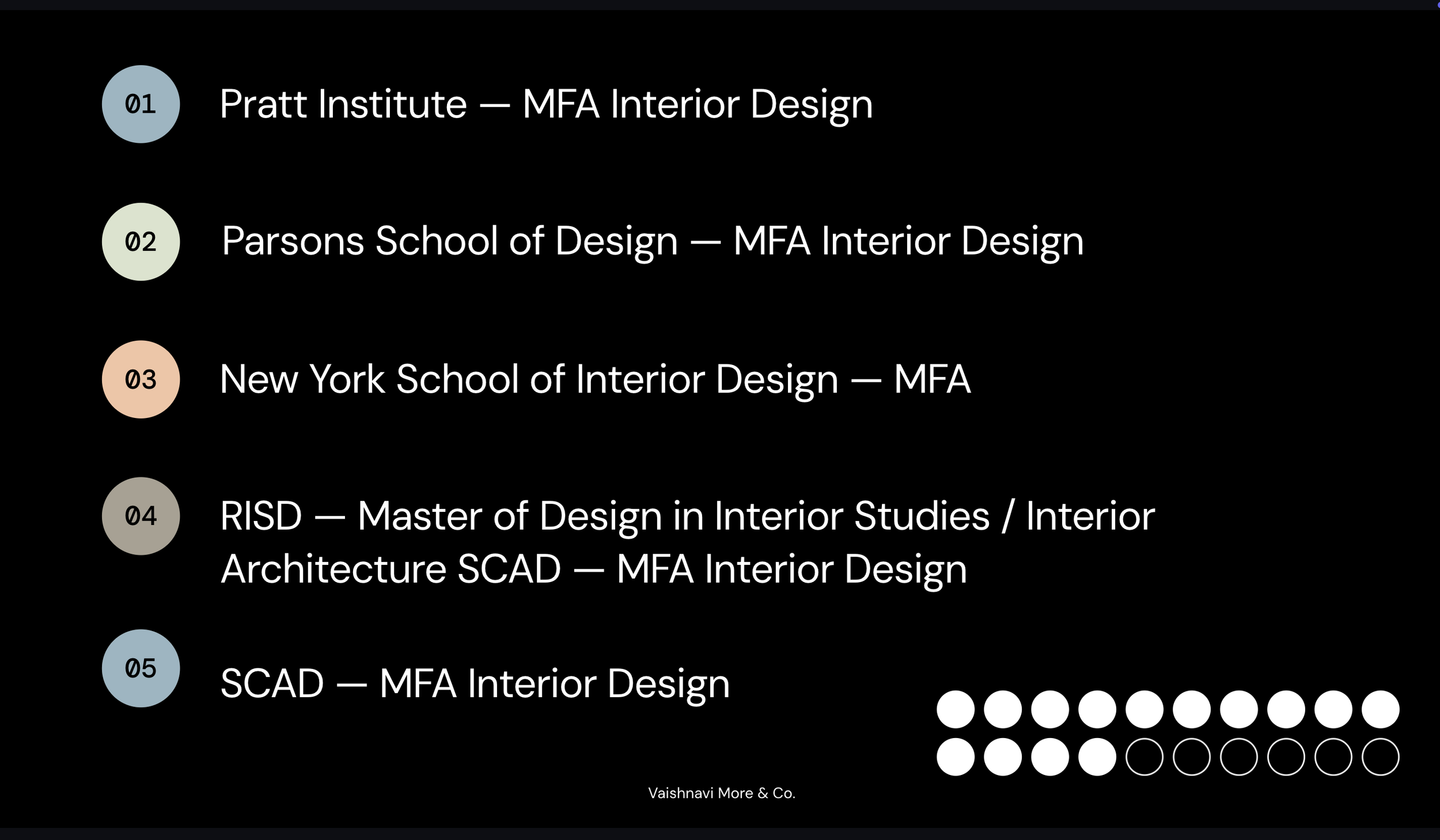
Top-tier Master's in Interior Design programs in the USA, including Pratt, Parsons, NYSID, RISD, and SCAD.
📐 New York School of Interior Design — MFA (MFA1 & MFA2)
The New York School of Interior Design (NYSID) stands out as the only institution in New York State to offer a first-professional MFA program with full Council for Interior Design Accreditation (CIDA) status.
NYSID deserves serious consideration precisely because it is so specialized.
One important thing applicants need to understand is that NYSID's portfolio expectations depend on the program. For MFA-1 applicants, the school currently asks for 10–15 pieces of fine-art work and specifically wants to see work made by hand and from life, such as drawing, painting and sculpture. Applicants to post-professional programs such as MFA-2 are expected to show professional-level interior design work.
That difference is critical. A portfolio appropriate for another interior design program may not automatically be appropriate for NYSID.
🧱 RISD — Master of Design in Interior Studies / Interior Architecture
RISD is worth exploring if you are interested in the intersection of interiors, architecture, adaptive reuse and existing buildings.
Its Interior Architecture graduate programs emphasize interventions into existing structures, with design studios at the center of the curriculum.
For a student interested in adaptive reuse, spatial transformation, material experimentation or working with existing architecture rather than simply designing new interiors, RISD can offer a very different academic direction.
🌴 SCAD — MFA Interior Design
SCAD’s Master of Fine Arts in Interior Design delivers a highly structured, corporate-connected graduate environment tailored for rapid placement in commercial design firms.
The curriculum masterfully merges collaborative design studios with environmental psychology, commercial lighting design, contemporary global issues, and inclusive universal design principles. As a STEM-designated graduate track, international students gain a significant competitive edge when applying for design roles at top-tier global hospitality, corporate, and retail design firms across the US.
Who Should Apply: SCAD is a fantastic choice if you want to master high-end digital design workflows, interface directly with real-world corporate sponsors during your studios, and graduate with a practice-ready portfolio.
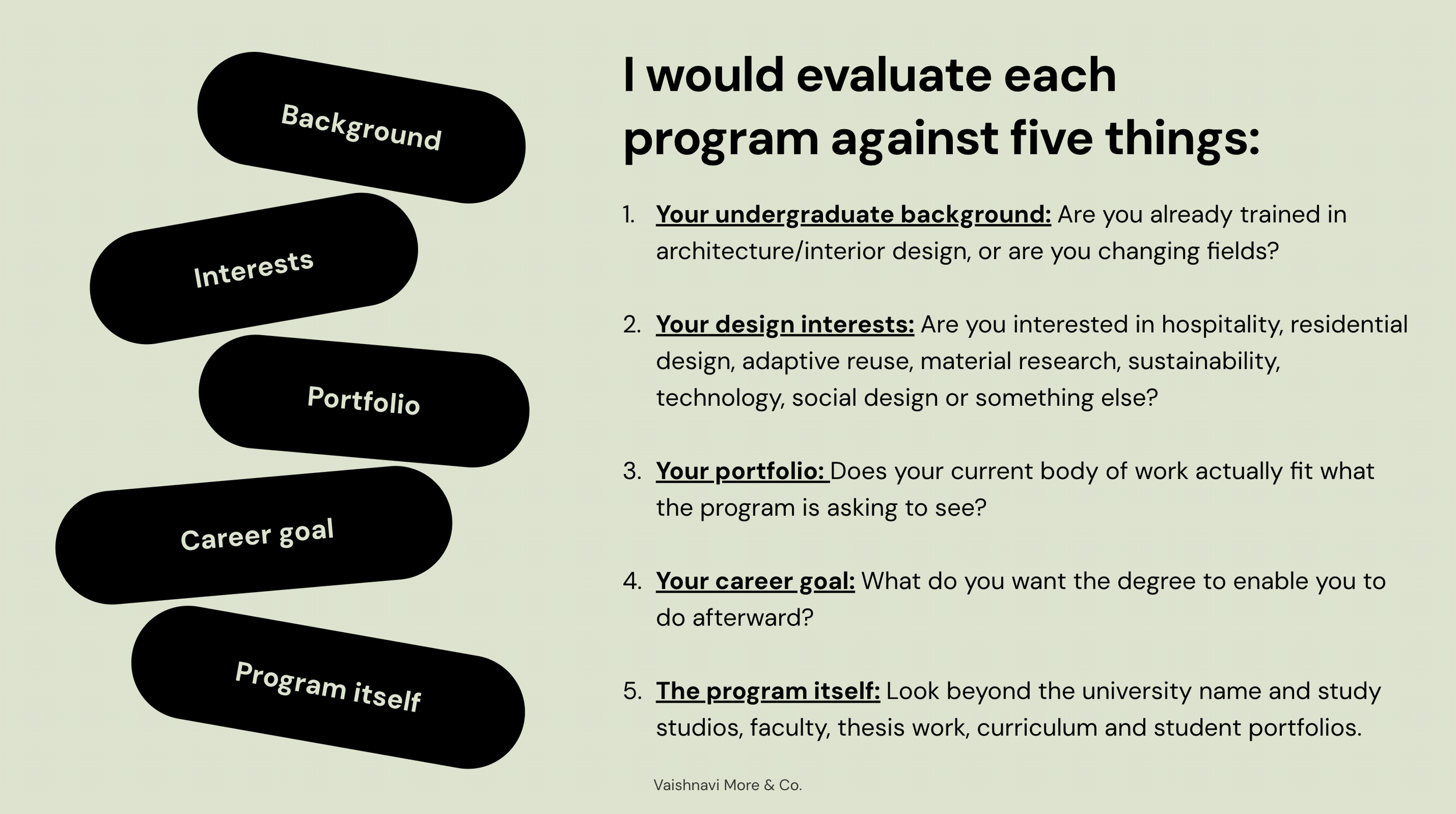
5 critical pillars to evaluate when building your graduate school list for interior design.
How should you choose?
Do not build your school list entirely around brand names. I would evaluate each program against five things:
Your undergraduate background. Are you already trained in architecture/interior design, or are you changing fields?
Your design interests. Are you interested in hospitality, residential design, adaptive reuse, material research, sustainability, technology, social design or something else?
Your portfolio. Does your current body of work actually fit what the program is asking to see?
Your career goal. What do you want the degree to enable you to do afterward?
The program itself. Look beyond the university name and study studios, faculty, thesis work, curriculum and student portfolios.
The strongest university list is not necessarily the one containing the most famous schools. It is the one where your background, portfolio, interests and future direction make sense together.
Book a 1:1 strategy session with Vaishnavi More to curate your customized US university list.
Navigating American graduate design admissions requires a highly customized blueprint. I work 1:1 with international applicants targeting competitive Master’s programs in Interior Design, Architecture, and spatial fields across the United States.
Ready to cut through the confusion and maximize your admissions odds? Book your personalized Master's Program Strategy Session today. We will audit your current portfolio, evaluate your academic goals, and curate an optimized university list engineered for your long-term success.